Free and open-source
EUPL-1.2 licensed, with no commercial interest behind the project.
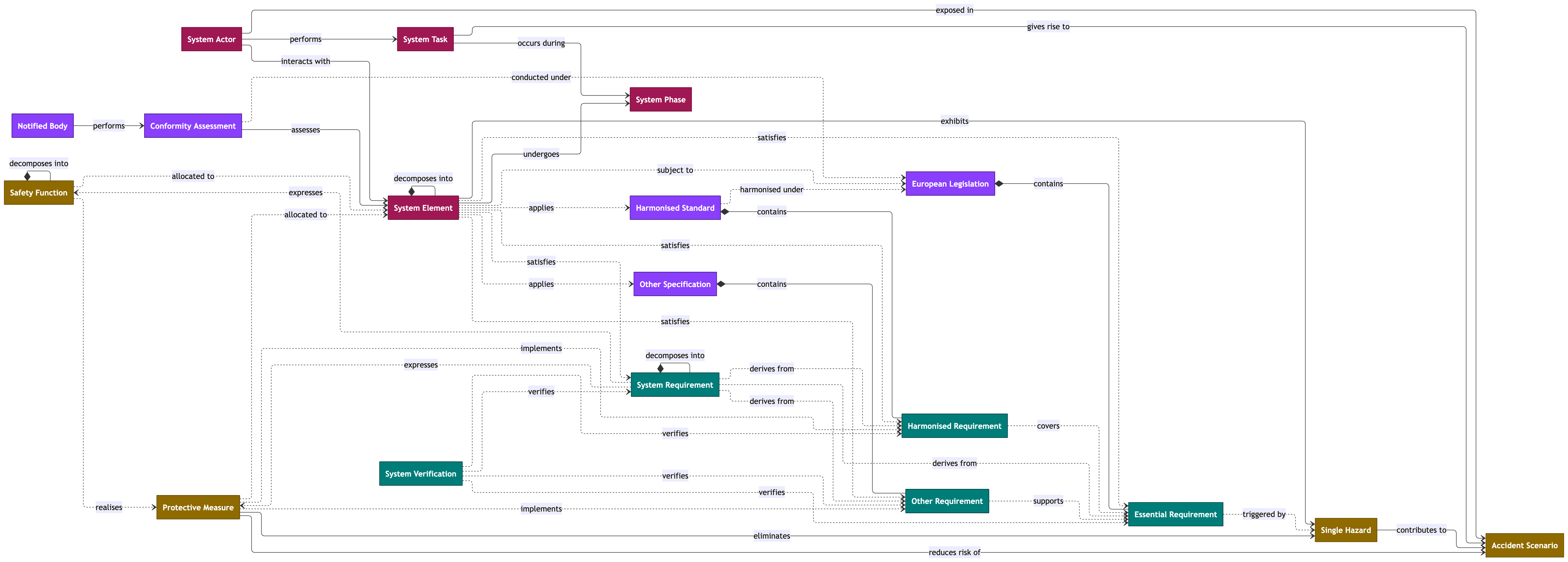
CE marking has many inherent relationships. The essential requirements, the harmonised standards, the identified hazards and the protective measures all trace to one another in different ways. The tool holds all of this together in one model, from which the engineering artefacts are derived.
The tool is in beta.

EUPL-1.2 licensed, with no commercial interest behind the project.
No account and no server, so each project is saved as a local file on your machine.
Nothing to install or maintain, just open the page and start working.
No box ticking, and no statement on the safety or compliance of the machine.
An entity is created once and related to the others, never repeated.
Export the results, intended as input to whatever process you already have.
A metamodel is a model of a model. Where a model describes one machine, the metamodel describes what any model may contain. Hardcoded into the tool, it defines which entities exist and how they may be related to one another. The relationships form chains that can be followed in either direction, from a system element down to a protective measure, or from that measure back to the system element.